London, United Kingdom
info@siaacsconsulting.co.uk

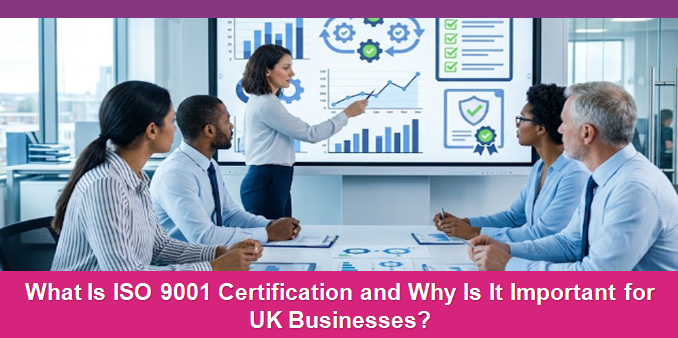
Businesses across the UK face increasing pressure to maintain quality, improve customer satisfaction, and remain competitive in their industries. Whether you operate a small business, a growing company, or a large organisation, having effective processes in place is essential for long-term success. This is where ISO 9001 Certification becomes valuable.
ISO 9001 is the world's most recognised Quality Management System (QMS) standard. It provides a structured framework that helps businesses improve efficiency, consistently deliver quality products or services, and meet customer expectations.
In this guide, we explain what ISO 9001 Certification is, how it works, and why it is important for UK businesses.
ISO 9001 Certification is a standard for quality management that was developed by the International Organisation for Standardisation (ISO) and is recognised around the world. This standard helps organisations design and implement processes that enhance the overall company performance and the satisfaction of customers.
Certification shows that a company’s Quality Management System (QMS) is in accordance with the standards that are accepted worldwide.
Instead of concentrating on the company’s products or services, ISO 9001 takes into account the company’s operations, the management of risks, the assessment of performance, and the improvement of the company’s processes.
A Quality Management System is the framework that a company uses to effectively carry out its operations. It is made up of documented processes, policies, tasks and roles that are designed to ensure that quality is maintained.
The benefits of having a QMS are:
The framework for an effective Quality Management System is provided by ISO 9001.
There are a number of management principles that are the basis of ISO 9001, and that help businesses to achieve success that is sustainable.
Customer Focus
Businesses must know what the requirements of their customers are and must meet, and when possible, exceed, those requirements.
Leadership
In order to have a business-wide culture of quality, strong leadership and the establishment of quality-related goals are needed.
Process Approach
In order to manage tasks effectively, businesses are encouraged to manage activities that are related to each other as processes.
Continuous Improvement
To achieve growth that is sustainable in the long run, businesses must seek improvements that are ongoing.
Evidence-Based Decision Making
Decisions that are made in the course of business activities must be based on evidence, assessments of performance, and analyses that are objective.
There are several benefits that make pursuing ISO 9001 Certification attractive for many businesses in the UK, both for operational and commercial benefits.
Certification ensures that an organisation is committed to quality assurance, and customers are more likely to trust and do business with organisations that adhere to international quality standards.
ISO 9001 inspires organisations to audit and improve their processes. This helps manage and control the processes while improving productivity and reducing wastage.
ISO certification is a requirement for many public and private tenders. ISO 9001 improves the chances of winning government contracts.
Growth makes keeping quality consistent a challenge for an organisation. However, ISO 9001 helps maintain quality through a scalable framework.
Operational Standards provoke organisations to manage and mitigate the risk of system failures before they occur.
The ISO 9001 certification process consists of several steps.
An audit is performed to understand where improvements must be made to meet the criteria of certification.
Policies, processes, procedures, and supporting documents are created, reviewed, and revised to satisfy the requirements of ISO 9001.
The approved processes are documented and implemented across the organisational functions of interest.
An internal audit is performed to verify conformance and determine areas where the system can be improved.
An external audit is conducted by an accreditation body to verify conformance to the requirements of ISO 9001.
The organisation is granted ISO 9001 Certification.
The ISO 9001 services provided at https://siaacsconsulting.co.uk/iso-9001/ provide valuable assistance to organisations that wish to be guided through the steps to certification.
Some organisations prefer to integrate ISO 9001 with other internationally accepted standards.
For instance, organisations that are focused on the management of their environmental performance may prefer to also obtain ISO 14001 certification, while organisations that are focused on the management of occupational health and safety may prefer to implement ISO 45001.
The integration of these standards may promote higher levels of performance and efficacy of the organisation.
This is false. ISO 9001 certification may be beneficial to enterprises of all sizes, including small- and medium-sized enterprises.
Unlike the goals of previous versions of the standard, modern ISO 9001 systems emphasise effective process management over the management of excessive documentation.
Once an entity gets certified, many believe that it no longer has to worry about maintaining that certification. This belief stems from a general lack of knowledge about the certification process, so, for the sake of this article, let us demystify that.
Conclusion
ISO 9001 certification is one of the most beneficial accreditations for businesses in the UK. The certification enables the business to develop and refine the quality of its products and services. The business can also develop and strengthen its relationship with its clientele, eliminate waste, and increase the overall efficiency of the business.
ISO 9001 has provided businesses with the support they need to embark on a journey to achieve their goals, whether the objectives are to nurture and promote sustained growth and/or economic development through the establishment of a framework to systematise and correlate business tasks.
For businesses thinking of achieving ISO 9001 certification, SIA ACS Consulting has an expert team to support you through the certification process. You can find out more about the consultancy services on their website, https://siaacsconsulting.co.uk/, and their ISO 9001 solutions.