London, United Kingdom
info@siaacsconsulting.co.uk

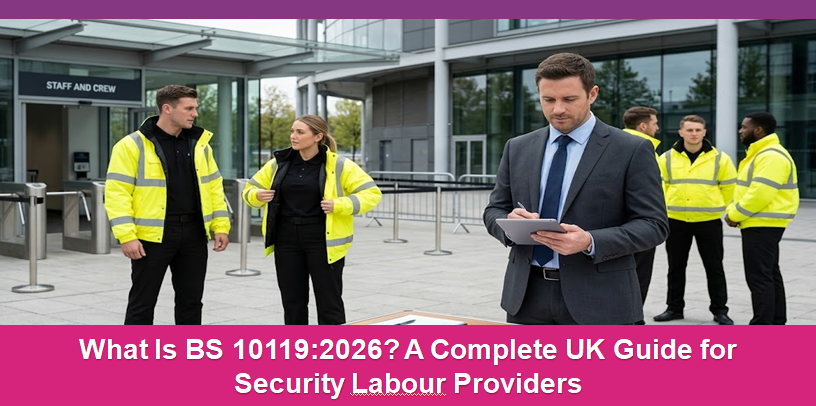
Finding workers is just the first step to managing temporary security staff for many businesses. Companies must also ensure their workers are thoroughly vetted, legally employed, trained and licensed where required.
This is where BS 10119:2026 is useful.
Published by the British Standards Institution (BSI) on 30 June 2026, BS 10119:2026 provides recommendations for organisations that provide additional or bought-in labour to security and event businesses.
For UK security labour providers, this understanding can help reduce risks in their operations, enhance their compliance and give their clients and contractors reassurance.
This UK code of practice is concerned with the management and supply of labour in the security and events sectors.
BS 10119 applies to organisations that provide security or event personnel to other organisations, including companies providing security officers, stewards and other event or security personnel.
This standard is concerned with how labour is sourced, managed, and screened, and the arrangements labour providers have with their clients.
BS 10119, according to the BSI, also covers other areas including the terms of employment, employee documentation and records.
More or less, BS 10119 addresses the following:
Can security labour providers evidence that they supply people through controlled, lawful and professionally managed processes?
This is relevant to businesses that provide additional security or event labour to contractors, security companies and event organisations.
One of the major changes for UK security businesses in 2026 will be moving from the previous NCP 119/COP 119 framework to BS 10119.
According to The National Security Inspectorate (NSI), it developed NCP 119 as a Code of Practice for the provision of labour in the security and events sectors. This work was later developed into BS 10119. NSI said that BS 10119 was published on the 30th of June, 2026.
This means that security labour providers that previously operated around COP 119 or NCP 119 should evaluate what changes are required in their systems to accommodate BS 10119.
BS 10119 is more applicable to companies that provide labour to security contractors, event companies and organisations that have strict supplier requirements.
It is important that organisations that have achieved BS 10119 certification do not treat the certificate as just another award. It is a holistic way of managing the supply of labour and compliance of workers and providing evidence to support it.
BS 10119:2026 is primarily relevant to organisations involved in supplying labour to the security and events sectors.
This can include:
Businesses supplying security officers or event staff to other organisations
BSI specifically identifies providers of security and events staff, event and property managers, and contractors procuring supplementary labour among the intended users of the standard.
If your business supplies personnel to another company rather than simply employing people for internal use, BS 10119 may be particularly relevant to your operations.
BS 10119 takes a broad approach to labour provision. It is not only about whether a worker has an SIA licence.
The standard looks at the systems and controls used by the labour provider.
Recruitment and Screening
A professional labour supply process should begin with suitable recruitment and screening.
Businesses need appropriate processes to establish that workers are suitable for the roles they are being supplied to perform.
Where relevant, security screening should also be carried out in line with applicable requirements. BSI highlights security screening to BS 7858 where applicable as part of the wider compliance approach.
Where a role is an SIA-licensed activity, the labour provider needs to ensure that the relevant operative has the correct licence.
This is particularly important because UK law requires an SIA licence for relevant licensable activities carried out under a contract for services. GOV.UK confirms that licensable activities include areas such as manned guarding and key holding.
BS 10119 therefore works alongside the wider regulatory requirements affecting private security businesses rather than replacing them.
A labour provider also needs to consider whether workers have the right to work in the UK and whether their employment arrangements are properly managed.
BSI identifies right-to-work checks, employment status checks, working time requirements, PAYE and data protection among the regulatory areas that BS 10119 can help organisations control.
Supplying workers is not simply about recruitment.
Security and event staff need appropriate knowledge, skills and preparation for the work they are being asked to perform.
BS 10119 includes training and competence within its wider labour management approach. This can help businesses demonstrate that staff are being supplied for roles they are suitably prepared to perform.
Where personal protective equipment is required, labour providers need appropriate arrangements for its provision and management.
The standard also considers employment conditions and the practical arrangements surrounding supplied personnel.
Good records are essential for demonstrating compliance.
A labour provider may need to maintain evidence relating to recruitment, screening, licences, right-to-work checks, training, employment arrangements and deployed personnel.
This documentation can become particularly important during certification audits, customer reviews or supplier assessments.
The security industry depends heavily on trust.
A contractor using a labour provider needs confidence that the people being supplied are properly managed and that the labour provider has suitable controls in place.
BS 10119 can help provide a structured framework for this.
BSI identifies several potential benefits, including risk mitigation, regulatory compliance, reputation management, recruitment and customer confidence.
For a security labour provider, this can translate into several practical benefits.
BS 10119 can help businesses create clearer processes around recruitment, licensing, right-to-work checks, employment documentation and worker records.
Certification against a recognised British Standard can give contractors and customers additional confidence when selecting a labour provider.
Larger security contractors may require their suppliers and labour providers to demonstrate appropriate compliance arrangements.
Having structured systems can make it easier to respond to customer due-diligence requests.
Poorly controlled labour supply can expose a business to compliance, financial and reputational risks.
A structured framework can help identify gaps before they become larger problems.
Certification can also become part of a company's credibility when competing for contracts.
For labour providers operating in a competitive UK security market, demonstrating recognised standards can help communicate professionalism and commitment to responsible labour practices.
There is particular relevance of BS 10119 to businesses who are working to or maintaining their SIA Approved Contractor Scheme (ACS) status.
The SIA has provided new ACS guidance that covers the period to 2026. There are specific aspects of this guidance that relate to BS, temporary workers, security for events and the use of subcontractors.
The SIA has also advised ACS clients to undertake due diligence on suppliers and subcontractors to verify SIA approval and vetting status.
It is important to understand that BS 10119 and the SIA ACS are separate and distinct.
The SIA Approved Contractor Scheme (ACS) is a service approval scheme operated by the SIA.
BS 10119 focuses on the provision of security and events workforce.
A business that operates in this area should understand the separate and distinct approvals that apply to their business rather than assume that one approval scheme automatically replaces the other.
If a business wants BS 10119 certification, they should first ensure that their current processes are efficient and identify any deficiencies that they may have.
Prior to the certification process, a business may want to review some or all of the following:
We want to avoid creating pointless forms and processes for an audit. The idea is to create a system that supports the core function of the business, and that can be audited without undue burden.
Certification to BS 10119 includes an assessment by an independent certification body.
The business is required to demonstrate that its systems and processes cover the relevant requirements of the standard and that there is adequate evidence to support the claims.
This is the reason for the preparation.
A business may have well-planned systems in place, but during an audit it may still suffer due to inconsistent systems, undocumented systems and processes, or systems that are very difficult to evidence.
A BS 10119 gap analysis can help identify the weaknesses and blind spots before the certification process.
Consultancy services can also help a business understand the standard, organise its documentation, optimise its processes and prepare itself for assessment.
The independent certification body makes the final decision on certifications.
Why UK Security Businesses Should Care About BS 10119
In 2026, the British Security Industry Association (BSIA) published British Standard (BS) 1011,9 which focuses on the provision of security and related staff. This British Standard provides the UK security and events sectors with a current British Standard.
This British Standard changes the terminology used in the BS 10119sector from the previous COP 119 and NCP 119.
This British Standard gives the framework for looking at recruitment, screening and staff employment, right-to-work checks, training and client relationships.
Besides the 2026 SIA ACS updates showing that BS is becoming more important in the compliance area for security businesses, the sudden focus on temporary workers and subcontractors highlights that more work is required.
BS 10119 focuses on gaps in process and control in security businesses providing labour. Therefore, it makes sense that security businesses should look at BS 10119 before taking the step towards certification.
Preparing for BS 10119 certification in the UK can be easier when your business has a clear understanding of the standard and the evidence required.
SIA ACS Consulting provides support for businesses looking to prepare for BS 10119 certification, including reviewing existing processes, identifying compliance gaps and helping organisations prepare their documentation and systems for assessment.
If your company supplies security or event labour and you are moving from the previous COP 119/NCP 119 framework towards BS 10119:2026, now is a good time to review your current arrangements and plan your certification journey.
Visit the BS 10119 service page to understand the available certification support and how your business can prepare for the requirements of this new UK standard.